Natural dog food: how to choose between cooked, BARF and kibble
Cooked, BARF or natural kibble: what they really mean, which dog each one suits and how to make the switch without upsetting their stomach.

In this article
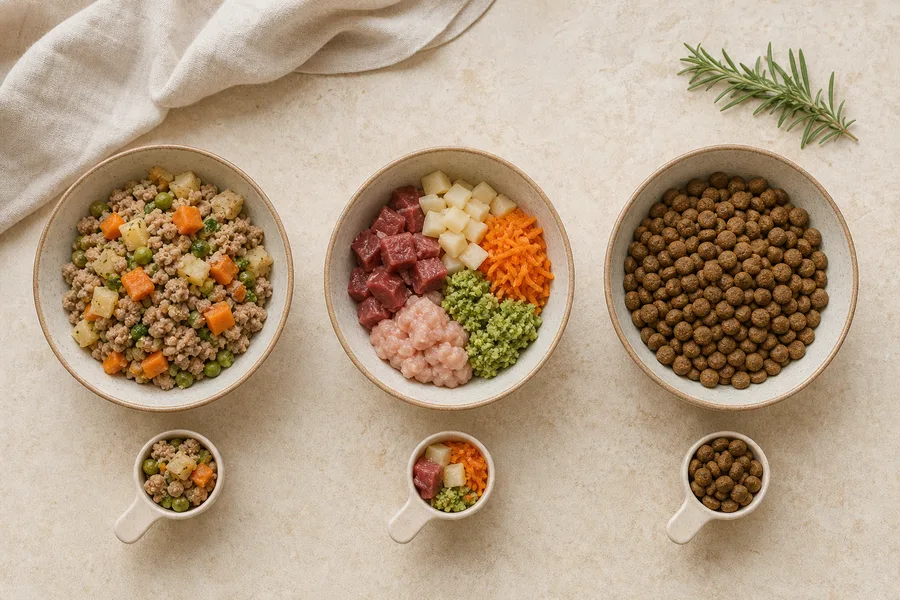
If you’re comparing natural dog food, here’s the short answer: there’s no single “best” option, only the one that fits your dog, your time and your budget. The three main routes are cooked food, the BARF (raw) diet and natural kibble. Below we explain how they really differ and how to choose without getting swept up in the marketing.
What “natural food” really means (and what it doesn’t)
“Natural” isn’t a regulated label, so every brand uses it in its own way. In practice, it refers to food made with recognisable, minimally processed ingredients —meat, fish, offal, vegetables— as opposed to ultra-processed products. What really matters isn’t the word “natural”, but two things:
- That the diet is complete and balanced (that it covers all the nutrients your dog needs).
- That you can keep it up over time without it becoming a logistical or financial ordeal.
Cooked food: the middle ground
Cooked food starts from fresh ingredients that are gently cooked at a low temperature. It keeps much of the appeal of natural food (palatability, digestibility) without any handling of raw ingredients.
- Who it suits: dogs with sensitive digestion, owners who want to make the leap to natural food without complications, and households with children or immunocompromised people (less microbiological risk than raw).
- Bear in mind: it needs refrigeration and proper storage. If you buy ready-formulated meals, check that they are complete.
BARF diet: raw and biologically appropriate
The BARF diet (Biologically Appropriate Raw Food) is based on raw ingredients: meat, meaty bone, offal and some plant matter. The idea is to get closer to what a dog would eat in the wild.
- Who it suits: owners willing to formulate it rigorously (or to buy ready-balanced BARF meals) and to handle raw food hygienically.
- Watch out for this: a poorly calculated BARF diet easily becomes unbalanced (too much bone, too few nutrients). And it isn’t advisable for immunocompromised dogs or homes shared with people at risk. If in doubt, have your vet sign off on it.
Natural kibble: convenient, but read the label
Natural kibble is still kibble: convenient, shelf-stable and cheap to store. What sets it apart from conventional kibble is the quality of the ingredients and how much “filler” it contains.
- Who it suits: anyone who prioritises convenience and price, or as a base to combine with wet food.
- Golden rule: if you don’t understand the label, be suspicious. The higher up a specific protein source appears (rather than “by-products”), the better.
How to decide in 3 questions
- How much time and logistics do you have? Little → subscription cooked meals or kibble. Plenty → well-formulated homemade BARF.
- Does your dog have digestive or weight problems? Yes → cooked food is usually the most rewarding change; talk it over with your vet.
- What budget can you realistically sustain each month? The best diet is the one you can keep up without giving up on it after two months.
How to switch without digestive upsets
Switch gradually, over 7-10 days, mixing in more and more of the new food with the old. A sudden change is the most common cause of diarrhoea when moving to a natural diet. If discomfort appears and doesn’t ease off, pause and check with your vet.
Frequently asked questions
Is natural food always better than kibble?
Not necessarily. A well-formulated natural food has advantages in digestibility and hydration, but a good balanced kibble is also a valid option. What’s decisive is the nutritional balance and whether you can keep it up.
Can I cook my dog’s food myself?
Yes, but only with recipes designed by a veterinary nutritionist. Cooking “by eye” on an ongoing basis is the fast track to deficiencies.
Is the BARF diet dangerous?
It isn’t “dangerous” in itself, but it demands correct formulation and strict hygiene. It isn’t the best option in households with immunocompromised people.
Keep reading
Rovinfood alternatives: price, cat coverage, reviews (2026)
Rovinfood costs up to €13/kg on one-off orders and has an 8-pack minimum. We compare the alternatives on price, format and commitment.
 Comparisons & guides
 Puromenú alternatives: price, cat range and reputation compared (2026)
Puromenú publishes its prices like no other brand in the sector, but its Trustpilot score weighs on the decision. We compare who solves each reason to switch.
 Comparisons & guides
 How much natural cat food really costs per month (verified prices, 2026)
The same honest math we did for dogs, now for cats: real monthly cost by weight and brand, with prices verified the same day across the four brands that cover cats.